

What is the signal - to - noise ratio of 800G OSFP DR8+?
In the high - paced world of data communication, the demand for high - speed, reliable, and efficient optical transceivers is ever - increasing. As a leading supplier of 800G OSFP DR8+ optical transceivers, I am often asked about various technical aspects of our products, and one question that frequently arises is about the signal - to - noise ratio (SNR) of the 800G OSFP DR8+.
The Basics of Signal - to - Noise Ratio
Before delving into the specifics of the 800G OSFP DR8+ SNR, let's first understand what SNR is. The signal - to - noise ratio is a fundamental metric in telecommunications and electronics. It represents the ratio of the power of a desired signal to the power of background noise. In simpler terms, it shows how much of the transmitted data (the signal) can be clearly distinguished from unwanted interference (the noise).
Mathematically, SNR is usually expressed in decibels (dB) using the formula: (SNR_{dB}=10\log_{10}(\frac{P_{signal}}{P_{noise}})), where (P_{signal}) is the power of the signal and (P_{noise}) is the power of the noise. A higher SNR value indicates a cleaner signal with less interference, which is crucial for accurate data transmission.
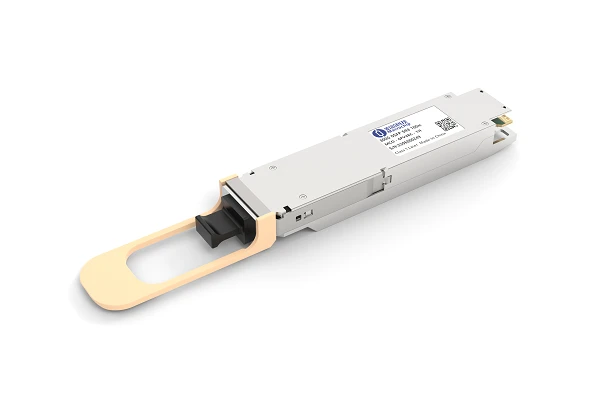

Importance of SNR in 800G OSFP DR8+
In the context of 800G OSFP DR8+ transceivers, a high SNR is of paramount importance. These transceivers are designed to support extremely high data rates of up to 800 gigabits per second (Gbps). At such high speeds, even a small amount of noise can cause significant errors in data transmission, leading to packet loss, data corruption, and reduced network performance.
A good SNR ensures that the data sent through the 800G OSFP DR8+ transceiver is accurately received at the other end. This is especially critical in data centers, where large amounts of data are transferred between servers, storage systems, and network switches. Any degradation in the SNR can result in costly downtime and inefficiencies.
Factors Affecting the SNR of 800G OSFP DR8+
Several factors can influence the SNR of an 800G OSFP DR8+ transceiver:
- Optical Fiber Quality: The quality of the optical fiber used in the transmission link plays a significant role in determining the SNR. Low - quality fibers can introduce more attenuation and scattering, which increase the noise level. For example, if the fiber has impurities or improper bending, it can cause signal loss and generate additional noise.
- Transmitter and Receiver Design: The design of the transmitter and receiver components in the 800G OSFP DR8+ transceiver is crucial. A well - designed transmitter can generate a strong and clean signal, while a high - performance receiver can accurately detect the signal even in the presence of some noise. Advanced signal processing algorithms can also be used to improve the SNR by filtering out unwanted noise.
- Environmental Conditions: Temperature, humidity, and electromagnetic interference (EMI) can all impact the SNR. High temperatures can cause the components in the transceiver to generate more noise, while EMI from nearby electrical equipment can introduce external interference. For instance, in a data center with a lot of power - hungry equipment, proper shielding and cooling are essential to maintain a good SNR.
Measuring the SNR of 800G OSFP DR8+
Measuring the SNR of an 800G OSFP DR8+ transceiver is a complex process that requires specialized equipment. One common method is to use an optical spectrum analyzer. This device can separate the signal from the noise and measure their respective powers. By comparing the signal power and the noise power, the SNR can be calculated using the formula mentioned earlier.
Another approach is to use bit error rate (BER) testing. In BER testing, a known sequence of data is sent through the transceiver, and the number of bit errors at the receiver is measured. A lower BER indicates a higher SNR because the signal is more accurately received.
Typical SNR Values for 800G OSFP DR8+
The typical SNR values for 800G OSFP DR8+ transceivers can vary depending on the specific design and operating conditions. However, in general, a good 800G OSFP DR8+ transceiver should have an SNR of at least 20 - 30 dB. This range ensures reliable data transmission at the high data rates supported by these transceivers.
Comparison with Other 800G Transceivers
When compared to other 800G transceivers such as QSFP DD 800G, the 800G OSFP DR8+ offers several advantages in terms of SNR. The OSFP form factor is designed to provide better thermal management, which can help reduce the noise generated by the components. Additionally, the DR8+ technology used in these transceivers is optimized for high - speed, low - noise data transmission.
Our 800G OSFP DR8+ Offerings
As a supplier of 800G OSFP DR8+ transceivers, we are committed to providing products with high SNR values. Our transceivers are designed using the latest technologies and undergo rigorous testing to ensure optimal performance. We use high - quality optical components and advanced signal processing algorithms to minimize noise and maximize the SNR.
Our Optical Transceiver 800G and Optical Module 800G solutions are known for their reliability and high - performance. Whether you are building a new data center or upgrading an existing one, our 800G OSFP DR8+ transceivers can provide the high - speed, low - noise data transmission you need.
Conclusion
The signal - to - noise ratio is a critical parameter for 800G OSFP DR8+ transceivers. A high SNR ensures reliable data transmission at high speeds, which is essential for modern data centers and high - performance networks. As a supplier, we understand the importance of SNR and strive to provide products that meet the highest standards.
If you are interested in learning more about our 800G OSFP DR8+ transceivers or are looking for a reliable partner for your optical transceiver needs, please feel free to contact us. We are ready to engage in a detailed discussion about your requirements and help you find the best solutions for your network.
References
- "Fiber Optic Communication Systems" by Govind P. Agrawal
- "High - Speed Optical Networks" by R. Ramaswami, K. N. Sivarajan, and G. Sasaki
- Industry whitepapers on 800G optical transceivers