

As a supplier of 800G OSFP DR8+ optical transceivers, I am often asked about the heat dissipation design of these high - performance devices. In this blog post, I will delve into the intricacies of the heat dissipation design of 800G OSFP DR8+ and explain why it is so crucial for the reliable operation of these transceivers.
The Importance of Heat Dissipation in 800G OSFP DR8+
With the continuous growth of data traffic, the demand for high - speed optical transceivers has skyrocketed. The 800G OSFP DR8+ is at the forefront of this technological wave, offering ultra - high data rates of up to 800Gbps. However, as the data rate increases, so does the power consumption of the transceiver. Higher power consumption leads to more heat generation, and if not properly managed, this heat can have a detrimental impact on the performance and lifespan of the transceiver.
Excessive heat can cause a variety of problems. It can increase the bit error rate, leading to data transmission errors. It can also degrade the performance of the optical components, such as lasers and photodetectors, reducing their efficiency and reliability. In extreme cases, overheating can even cause permanent damage to the transceiver, resulting in costly replacements. Therefore, an effective heat dissipation design is essential for ensuring the stable and reliable operation of 800G OSFP DR8+ transceivers.
Key Components and Design Principles of Heat Dissipation
Heat Sources in 800G OSFP DR8+
The main heat sources in an 800G OSFP DR8+ transceiver are the electrical components, such as the driver chips, modulators, and digital signal processors (DSPs). These components consume a significant amount of power during operation, converting electrical energy into heat. Additionally, the optical components, especially the lasers, also generate heat when they emit light.
Heat Conduction
One of the fundamental principles of heat dissipation is heat conduction. In the design of 800G OSFP DR8+, heat - conductive materials are used to transfer heat from the heat sources to the outer surface of the transceiver. For example, copper and aluminum are commonly used as heat - conductive materials due to their high thermal conductivity. These materials are often used in the form of heat sinks or heat spreaders.
A heat sink is a passive heat exchanger that increases the surface area of the transceiver, allowing for more efficient heat transfer to the surrounding air. It is usually made of a metal with high thermal conductivity and has fins or other structures to increase its surface area. A heat spreader, on the other hand, is used to evenly distribute the heat across a larger area, making it easier for the heat to be dissipated.
Heat Convection
Heat convection is another important mechanism for heat dissipation. Convection occurs when heat is transferred from a solid surface to a fluid (such as air or liquid) through the movement of the fluid. In the case of 800G OSFP DR8+ transceivers, natural convection and forced convection are both used.

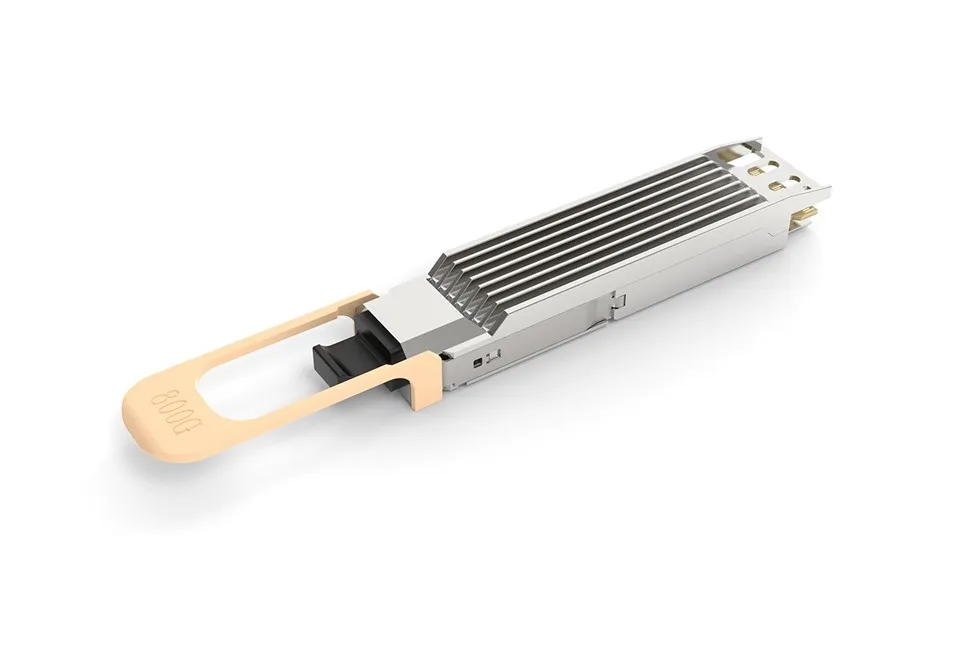
Natural convection relies on the buoyancy of the heated air. As the air near the transceiver heats up, it becomes less dense and rises, creating a natural airflow that carries the heat away. To enhance natural convection, the design of the transceiver often includes ventilation holes or channels to allow for better air circulation.
Forced convection, on the other hand, uses fans or other mechanical devices to create a forced airflow. This can significantly increase the heat transfer rate, especially in environments with limited natural airflow. However, forced convection also adds complexity and power consumption to the system.
Heat Radiation
Heat radiation is the transfer of heat through electromagnetic waves. All objects emit thermal radiation, and the rate of radiation depends on the temperature and emissivity of the object. In the design of 800G OSFP DR8+ transceivers, the outer surface of the transceiver is often treated to increase its emissivity, allowing for more efficient heat radiation.
Our Company's Heat Dissipation Design for 800G OSFP DR8+
As a leading supplier of [link text="800G Optical Module" url="/800g-optical-transceiver/800g-optical-module.html"], we have developed a comprehensive heat dissipation design for our 800G OSFP DR8+ transceivers.
Advanced Heat - Conductive Materials
We use high - quality copper and aluminum alloys in our heat sinks and heat spreaders. These materials have excellent thermal conductivity, ensuring efficient heat transfer from the heat sources to the outer surface of the transceiver. Our heat sinks are carefully designed with a large number of fins to maximize the surface area for heat transfer.
Optimized Airflow Design
Our 800G OSFP DR8+ transceivers are designed with a unique airflow path. The ventilation holes and channels are strategically placed to ensure smooth air circulation. In addition, we have conducted extensive computational fluid dynamics (CFD) simulations to optimize the airflow design, reducing the temperature rise inside the transceiver.
Thermal Interface Materials
We use high - performance thermal interface materials (TIMs) between the heat sources and the heat sinks. These TIMs fill the microscopic gaps between the surfaces, improving the thermal contact and reducing the thermal resistance. This allows for more efficient heat transfer from the heat sources to the heat sinks.
Testing and Validation of Heat Dissipation Design
Before our 800G OSFP DR8+ transceivers are released to the market, they undergo rigorous testing and validation to ensure the effectiveness of the heat dissipation design.
Thermal Testing
We use thermal imaging cameras and temperature sensors to measure the temperature distribution inside and outside the transceiver during operation. This allows us to identify any hot spots and evaluate the overall temperature rise. By comparing the test results with the design specifications, we can make necessary adjustments to the heat dissipation design.
Long - Term Reliability Testing
We also conduct long - term reliability testing on our transceivers. These tests simulate real - world operating conditions over an extended period of time. By monitoring the performance and temperature of the transceivers during the testing, we can ensure that they can operate reliably under different environmental conditions.
Conclusion
The heat dissipation design of 800G OSFP DR8+ is a critical aspect of its performance and reliability. By using advanced heat - conductive materials, optimizing the airflow design, and using high - performance thermal interface materials, we are able to effectively manage the heat generated by these high - speed transceivers.
If you are interested in our [link text="800g Optical Transceiver" url="/800g-optical-transceiver/800g-optical-transceiver-details.html"] or [link text="High Speed Optical Transceiver" url="/800g-optical-transceiver/high-speed-optical-transceiver.html"], or if you have any questions about the heat dissipation design or other aspects of our products, please feel free to contact us for further discussion and potential procurement. We are committed to providing you with high - quality products and excellent technical support.
References
- "Optical Fiber Communication Technology", John Wiley & Sons
- "Thermal Management in Electronic Systems", McGraw - Hill Education