

As a reliable supplier of 400G QSFP - DD LR4 transceivers, I am often asked about the transmission media options for this high - speed optical module. In this blog, I will explore the various transmission media suitable for 400G QSFP - DD LR4 and their characteristics.
Understanding 400G QSFP - DD LR4
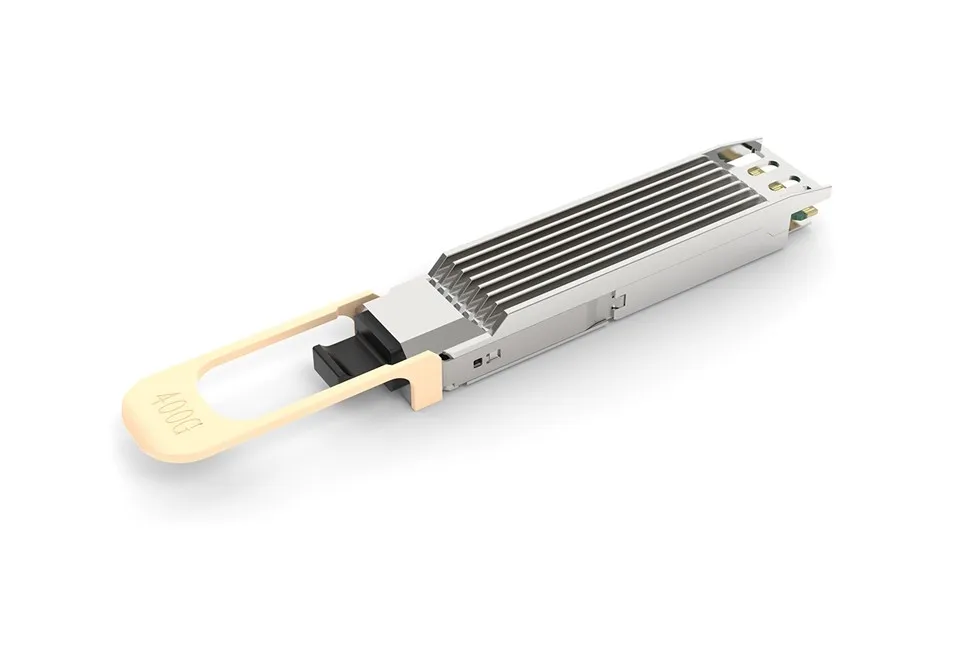
The 400G QSFP - DD LR4 is a high - performance optical transceiver designed for data center and telecommunications applications. It supports a data rate of 400 Gigabits per second (Gbps) over a long - reach distance, typically up to 10 kilometers. This transceiver uses four lanes of 100Gbps each, multiplexed using wavelength - division multiplexing (WDM) technology.
Transmission Media Options
Single - Mode Fiber (SMF)
Single - mode fiber is the most common and suitable transmission media for 400G QSFP - DD LR4. SMF has a very small core diameter (usually around 9 microns), which allows light to travel in a single mode, resulting in low attenuation and high bandwidth.
-
Advantages:
- Long - Distance Transmission: SMF can support transmission distances of up to 10 kilometers or more, which is ideal for long - haul data center interconnects and telecommunications networks. For example, in a large - scale data center where different racks or buildings need to be connected, SMF can ensure reliable data transfer over such distances.
- Low Attenuation: The attenuation of SMF is very low, typically around 0.2 dB/km at 1550 nm. This means that the signal can travel a long distance without significant loss, reducing the need for signal amplification.
- High Bandwidth: SMF can support high - speed data transmission, making it suitable for 400G QSFP - DD LR4 transceivers. It can handle the high data rates required for modern data - intensive applications.
-
Disadvantages:
- Higher Cost: SMF is generally more expensive than multimode fiber. The manufacturing process of SMF is more complex, and the cost of installation and maintenance is also relatively high.
- Requires Precise Alignment: When connecting SMF, precise alignment is required to ensure low insertion loss. This can be challenging during installation and may require specialized tools and skills.
You can find more information about Single Mode Optical Module on our website.
Multimode Fiber (MMF)
Although multimode fiber is not the primary choice for 400G QSFP - DD LR4 due to its limited distance capabilities, it can still be used in some short - range applications. MMF has a larger core diameter (usually 50 or 62.5 microns), which allows multiple modes of light to travel simultaneously.
-
Advantages:
- Lower Cost: MMF is generally less expensive than SMF, both in terms of the fiber itself and the installation cost. This makes it a more cost - effective option for short - range connections within a data center.
- Easier Installation: MMF is easier to install and align compared to SMF. It does not require the same level of precision as SMF, which can save time and labor during installation.
-
Disadvantages:
- Limited Distance: The transmission distance of MMF is limited, typically up to a few hundred meters. This is due to the modal dispersion, which causes the different modes of light to travel at different speeds and results in signal distortion over longer distances.
- Lower Bandwidth: MMF has a lower bandwidth compared to SMF, which may not be sufficient for high - speed applications such as 400G QSFP - DD LR4 over long distances.
Coaxial Cable
Coaxial cable was once a popular choice for data transmission, but it is less commonly used for 400G QSFP - DD LR4 due to its limitations in high - speed and long - distance transmission.
-
Advantages:
- Good Shielding: Coaxial cable has good shielding properties, which can reduce electromagnetic interference (EMI) and radio - frequency interference (RFI). This makes it suitable for applications where interference is a concern.
- Flexibility: Coaxial cable is relatively flexible and can be easily bent and routed, which is convenient for installation in tight spaces.
-
Disadvantages:
- Limited Bandwidth: Coaxial cable has a limited bandwidth compared to optical fiber, which makes it difficult to support high - speed data rates such as 400Gbps.
- High Attenuation: The attenuation of coaxial cable is relatively high, especially at high frequencies. This limits the transmission distance and requires the use of signal amplifiers.
Comparison of Transmission Media
| Transmission Media | Distance | Bandwidth | Cost | Installation Complexity |
|---|---|---|---|---|
| Single - Mode Fiber | Up to 10 km or more | High | High | High |
| Multimode Fiber | Up to a few hundred meters | Medium | Low | Low |
| Coaxial Cable | Short distances | Low | Medium | Medium |
Choosing the Right Transmission Media
When choosing the transmission media for 400G QSFP - DD LR4, several factors need to be considered:

- Distance: If the transmission distance is long (more than a few hundred meters), single - mode fiber is the best choice. For short - range connections within a data center, multimode fiber may be sufficient.
- Bandwidth Requirements: High - speed applications such as 400Gbps require a transmission media with high bandwidth, such as single - mode fiber.
- Cost: Cost is an important factor, especially for large - scale deployments. Multimode fiber is generally more cost - effective for short - range applications, while single - mode fiber is more suitable for long - range connections despite its higher cost.
- Installation and Maintenance: The ease of installation and maintenance should also be considered. Multimode fiber is easier to install and align, while single - mode fiber requires more precision.
Other Considerations
In addition to the transmission media, other factors such as the quality of the fiber connectors, the environmental conditions, and the network topology also need to be considered. High - quality fiber connectors can reduce insertion loss and improve the overall performance of the network. Environmental conditions such as temperature, humidity, and dust can also affect the performance of the transmission media.
Conclusion
As a 400G QSFP - DD LR4 supplier, I understand the importance of choosing the right transmission media for your network. Single - mode fiber is the most suitable option for long - distance and high - speed applications, while multimode fiber can be used for short - range connections. Coaxial cable is less commonly used for 400G QSFP - DD LR4 due to its limitations.
If you are interested in 400G QSFP112 DR4 or other Optical Module 400G products, or if you have any questions about the transmission media for 400G QSFP - DD LR4, please feel free to contact us for further discussion and procurement.
References
- "Optical Fiber Communication Systems" by Gerd Keiser
- "Data Center Networking" by Andrew L. Tanenbaum