

In the ever - evolving landscape of high - speed data transmission, the demand for faster and more efficient optical transceivers is on the rise. As a leading supplier of 400G OSFP DR4 optical transceivers, I often encounter a common question from our customers: "Is 400G OSFP DR4 suitable for long - haul transmission?" In this blog, we will delve into the technical aspects of 400G OSFP DR4 and evaluate its viability for long - haul applications.
Understanding 400G OSFP DR4
Before discussing its suitability for long - haul transmission, let's first understand what 400G OSFP DR4 is. The 400G OSFP (Octal Small Form - factor Pluggable) DR4 is a high - speed optical transceiver module designed to support data rates up to 400 Gigabits per second (Gbps). The "DR4" in its name indicates that it uses a Direct - Detect, 4 - lane design.
The OSFP form factor is relatively new and offers several advantages over its predecessors. It has a high port density, which means that more transceivers can be installed in a given space, making it ideal for high - density data center applications. The 4 - lane design allows for parallel data transmission, which significantly increases the overall data rate. Each lane operates at a speed of 100Gbps, and together they achieve the 400Gbps data rate.
Characteristics of Long - Haul Transmission
Long - haul transmission typically refers to the transfer of data over distances of tens to hundreds of kilometers. In long - haul networks, there are several key requirements that optical transceivers must meet.
Firstly, long - haul transmission requires high power budgets. As the signal travels over long distances, it experiences attenuation, which is the loss of signal strength. To ensure that the signal can reach the destination with sufficient strength, the transceiver needs to have a high output power and be able to detect weak signals at the receiver end.
Secondly, long - haul networks often use wavelength - division multiplexing (WDM) technology. WDM allows multiple signals of different wavelengths to be transmitted over a single fiber, increasing the capacity of the network. Transceivers used in long - haul applications need to be compatible with WDM systems.
Finally, long - haul transmission demands high reliability and stability. Any interruption in the signal can cause significant data loss and disrupt the operation of the network. Therefore, the transceivers need to have low bit - error rates (BER) and be able to withstand environmental factors such as temperature variations and humidity.
Analysis of 400G OSFP DR4 for Long - Haul Transmission
Power Budget
The 400G OSFP DR4 is primarily designed for short - to - medium - haul applications, typically up to 500 meters. It has a relatively low power budget compared to transceivers specifically designed for long - haul transmission. The signal attenuation over long distances can be too high for the 400G OSFP DR4 to compensate for. As the signal travels further, the power loss becomes more significant, and the receiver may not be able to accurately detect the signal, resulting in a high BER.
Wavelength - Division Multiplexing Compatibility
The 400G OSFP DR4 uses a direct - detect design, which is not inherently compatible with WDM systems. In long - haul networks, WDM is widely used to increase the capacity of the fiber. Transceivers that support WDM, such as the QSFP DD LR4, are more suitable for long - haul applications. The QSFP DD LR4 uses a coherent detection scheme and can be easily integrated into WDM networks.
Distance Limitations
The 400G OSFP DR4 is optimized for multi - mode fiber (MMF) or short - reach single - mode fiber (SMF) applications. Its distance limitation is mainly due to the design of the optical components and the signal modulation scheme. For long - haul transmission, where distances can reach hundreds of kilometers, the 400G OSFP DR4 is not the best choice.

Alternatives for Long - Haul Transmission
If long - haul transmission is the requirement, there are several alternatives to the 400G OSFP DR4.
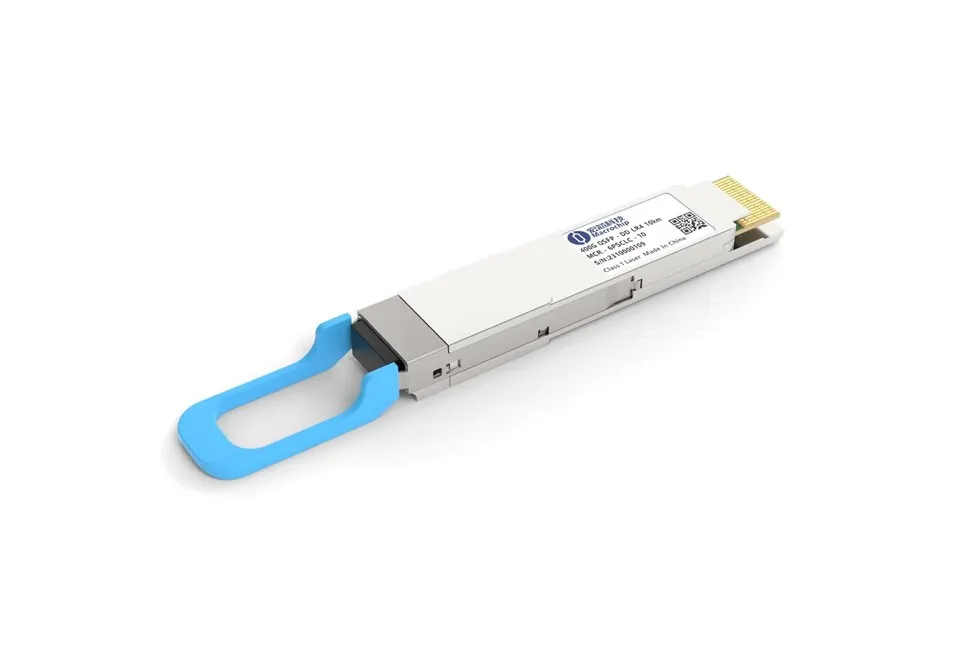
One option is the QSFP DD LR4. As mentioned earlier, the QSFP DD LR4 is designed for long - haul applications. It uses a coherent detection scheme, which provides better performance in terms of power budget and distance. The LR4 in its name stands for Long - Reach 4 - lane, indicating its suitability for long - distance transmission.
Another alternative is the 400G QSFP - DD SR8. Although it is mainly designed for short - reach applications, it can be used in some long - haul scenarios with the help of optical amplifiers. The 400G QSFP - DD SR8 offers high data rates and can be a cost - effective solution for certain long - haul networks.
When 400G OSFP DR4 Can Be Used in Long - Haul - Related Scenarios
While the 400G OSFP DR4 is not directly suitable for long - haul transmission, it can still play a role in long - haul - related scenarios. For example, in data centers that are connected to long - haul networks, the 400G OSFP DR4 can be used for internal data center connections. It can provide high - speed connectivity between servers and switches within the data center, and then the data can be transferred to the long - haul network using more suitable transceivers.
Conclusion
In conclusion, the 400G OSFP DR4 is not typically suitable for long - haul transmission due to its low power budget, lack of WDM compatibility, and distance limitations. However, it has its own advantages in high - density data center applications.
If you are looking for a solution for long - haul transmission, we recommend considering alternatives such as the QSFP DD LR4 or the 400G QSFP - DD SR8. As a professional supplier of optical transceivers, we offer a wide range of products, including the OSFP Optical Module, to meet your different needs.
If you have any questions about our products or need further advice on choosing the right optical transceiver for your application, please feel free to contact us. We are more than happy to assist you in making the best decision for your network.
References
- Cisco. "Optical Transceiver Technology Overview."
- Juniper Networks. "Long - Haul Transmission in Modern Networks."
- IEEE Standards Association. "Standards for High - Speed Optical Transceivers."