

In the ever - evolving landscape of data center technology, high - speed optical transceivers play a pivotal role in ensuring efficient data transfer. One such transceiver that has gained significant attention is the 400G QSFP - DD FR4. As a supplier of 400G QSFP - DD FR4 transceivers, I often encounter the question: Can 400G QSFP - DD FR4 be used in a data center interconnect (DCI) network? In this blog post, I will delve into the technical aspects, advantages, limitations, and practical considerations to provide a comprehensive answer.
Technical Overview of 400G QSFP - DD FR4
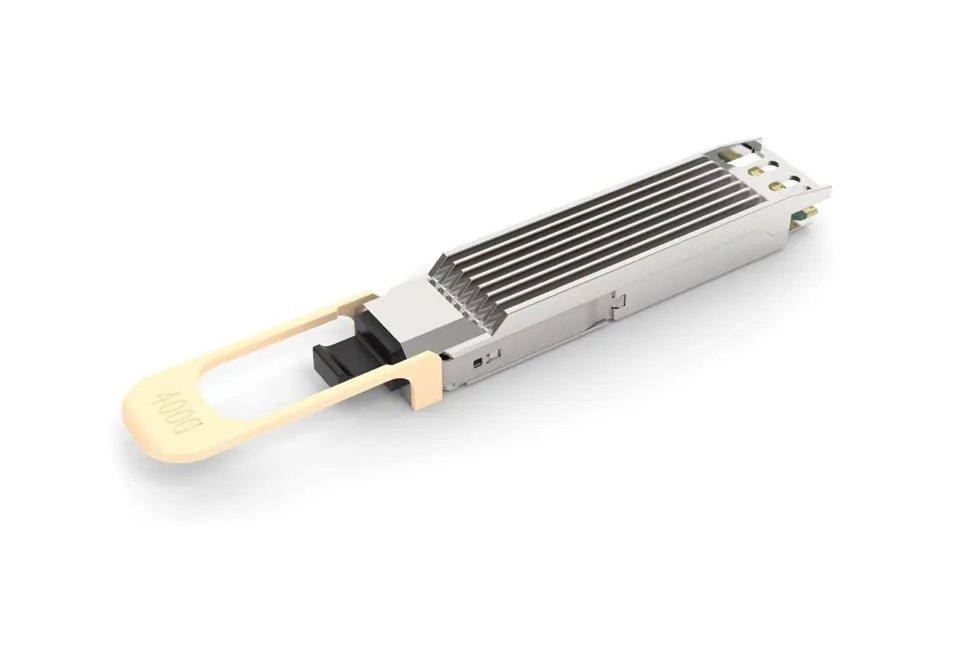
The 400G QSFP - DD FR4 is a high - speed optical transceiver designed to support a data rate of 400 Gigabits per second (Gbps). It follows the QSFP - DD (Quad Small Form - factor Pluggable Double Density) form factor, which is a compact and hot - swappable interface. The "FR4" in its name indicates that it is designed for a short - to - medium - reach fiber optic link, typically up to 2 kilometers over single - mode fiber (SMF).
The transceiver uses four lanes of 100Gbps each, with each lane operating at 25Gbaud PAM4 modulation. This modulation scheme allows for higher data rates within the same bandwidth compared to traditional non - return - to - zero (NRZ) modulation. The 400G QSFP - DD FR4 is compliant with industry standards such as IEEE 802.3bs and the QSFP - DD MSA (Multi - Source Agreement), ensuring interoperability with other compliant devices.
Requirements of a Data Center Interconnect (DCI) Network
A DCI network is used to connect multiple data centers together, enabling the transfer of large amounts of data between them. The requirements of a DCI network can vary depending on the specific application, but some common requirements include:
- High Bandwidth: With the increasing volume of data generated and processed in data centers, DCI networks need to support high - speed data transfer to ensure seamless communication between different data centers.
- Long - Distance Connectivity: Data centers can be located in different geographical locations, so DCI networks often require long - distance connectivity to span tens or even hundreds of kilometers.
- Reliability and Low Latency: To ensure the smooth operation of applications that rely on data center interconnectivity, DCI networks need to be highly reliable and have low latency.
Advantages of Using 400G QSFP - DD FR4 in DCI Networks
- High Bandwidth: The 400G QSFP - DD FR4 offers a high data rate of 400Gbps, which can meet the increasing bandwidth demands of DCI networks. This high - speed connectivity allows for the rapid transfer of large amounts of data, such as backup and recovery data, big data analytics, and cloud - based services.
- Cost - Effectiveness: Compared to some other high - speed optical transceivers designed for long - distance applications, the 400G QSFP - DD FR4 is relatively cost - effective. It uses standard single - mode fiber, which is widely available and less expensive than some specialized fiber types. Additionally, its compact form factor allows for high - density deployment, reducing the overall cost per port.
- Interoperability: As mentioned earlier, the 400G QSFP - DD FR4 is compliant with industry standards, which means it can be easily integrated into existing DCI networks that use other compliant devices. This interoperability simplifies the network upgrade process and reduces the risk of compatibility issues.
Limitations of Using 400G QSFP - DD FR4 in DCI Networks
- Limited Reach: The main limitation of the 400G QSFP - DD FR4 is its limited reach of up to 2 kilometers. In many DCI applications, data centers are located farther apart, and a 2 - kilometer reach may not be sufficient. For example, in a metropolitan area network (MAN) where data centers can be separated by tens of kilometers, the 400G QSFP - DD FR4 would not be suitable without the use of additional optical amplification or regeneration equipment.
- Signal Degradation: Over longer distances, the optical signal transmitted by the 400G QSFP - DD FR4 can experience degradation due to factors such as attenuation and dispersion. This can lead to an increase in bit - error rate (BER) and a decrease in the overall performance of the network.
Comparison with Other 400G Transceivers for DCI Networks
- QSFP DD SR8: The QSFP DD SR8 is designed for short - reach applications, typically up to 100 meters over multimode fiber (MMF). It uses eight lanes of 50Gbps each. While it offers high - speed connectivity, its short reach makes it unsuitable for most DCI applications where longer distances are required.
- 400G QSFP - DD DR4: The 400G QSFP - DD DR4 is designed for a reach of up to 500 meters over single - mode fiber. It has a longer reach than the QSFP DD SR8 but still falls short of the requirements for many DCI networks that need to span several kilometers.
- QSFP DD LR4: The QSFP DD LR4 is designed for a reach of up to 10 kilometers over single - mode fiber. It offers a longer reach compared to the 400G QSFP - DD FR4 and is more suitable for some DCI applications where the distance between data centers is within 10 kilometers. However, it may be more expensive than the 400G QSFP - DD FR4.
Practical Considerations for Using 400G QSFP - DD FR4 in DCI Networks
- Distance Assessment: Before considering the use of 400G QSFP - DD FR4 in a DCI network, it is essential to assess the distance between the data centers. If the distance is within 2 kilometers, the 400G QSFP - DD FR4 can be a viable option. Otherwise, alternative transceivers with longer reach should be considered.
- Network Topology: The network topology also plays a crucial role in determining the suitability of the 400G QSFP - DD FR4. In some cases, a combination of different transceivers may be required to achieve the desired connectivity. For example, 400G QSFP - DD FR4 can be used for short - distance connections within a data center campus, while other long - reach transceivers can be used for inter - campus connections.
- Future Expansion: When planning a DCI network, it is important to consider future expansion. As the data center grows and the demand for higher bandwidth and longer - distance connectivity increases, the network should be able to accommodate these changes. This may involve choosing transceivers that offer scalability or planning for the integration of additional optical equipment in the future.
Conclusion
In conclusion, the 400G QSFP - DD FR4 can be used in a DCI network under certain conditions. Its high bandwidth and cost - effectiveness make it an attractive option for short - to - medium - reach DCI applications where the distance between data centers is within 2 kilometers. However, its limited reach and potential signal degradation over longer distances are significant limitations. For DCI networks that require longer - distance connectivity, alternative transceivers such as the QSFP DD LR4 may be more suitable.

If you are considering implementing a DCI network and are interested in learning more about the 400G QSFP - DD FR4 or other optical transceivers, I encourage you to reach out to me for further discussion. I can provide you with detailed product information, technical support, and help you find the best solution for your specific needs.
References
- IEEE 802.3bs Standard for Ethernet
- QSFP - DD MSA (Multi - Source Agreement)